How to Measure Influencer Marketing ROI: 7 Proven Strategies for Indian Brands
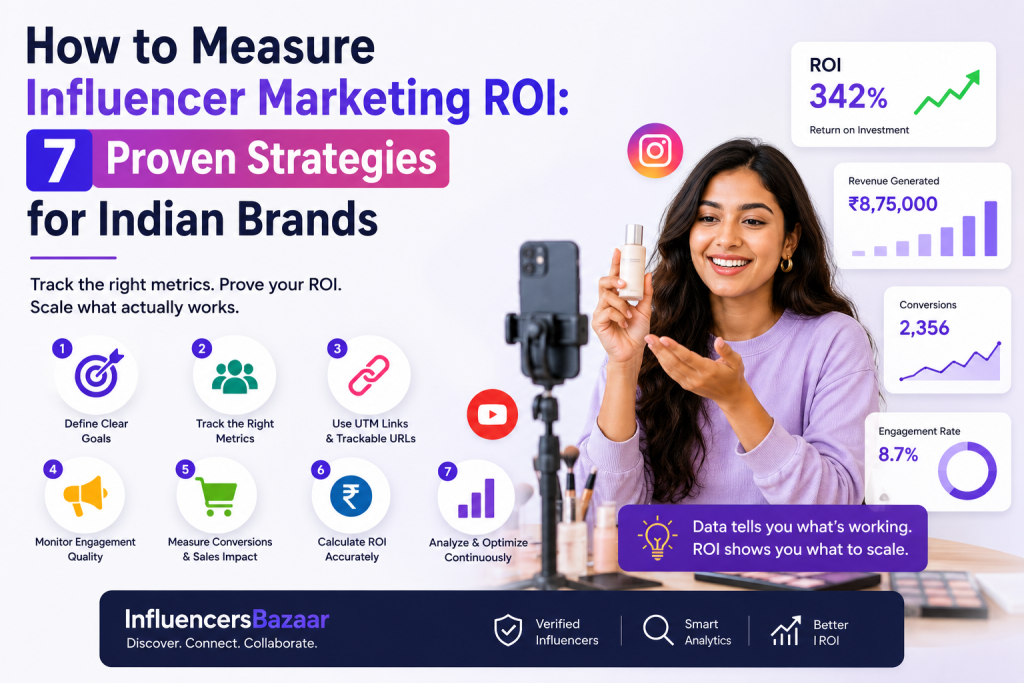
How to Measure Influencer Marketing ROI is essential for understanding whether your influencer campaigns are delivering real results. By tracking the right metrics, brands can identify top-performing creators, optimize budgets, and maximize campaign returns.
Quick Answer: Influencer marketing ROI is measured by comparing the value generated (reach, engagement, conversions, revenue) against the total campaign cost. For Indian brands, the most reliable ROI formula is: (Revenue Attributed to Campaign − Campaign Cost) ÷ Campaign Cost × 100. Track this using UTM links, unique discount codes, and real-time analytics from platforms like InfluencersBazaar.
What Is Influencer Marketing ROI?
Influencer marketing ROI (Return on Investment) measures how much value your brand receives in return for every rupee spent on creator campaigns.
ROI is not just about sales. Depending on your campaign goal, ROI can be measured in awareness (reach, impressions), engagement (likes, comments, shares, saves), conversions (website visits, app downloads, sign-ups), or direct revenue (purchases attributed to the influencer campaign).
Why ROI Measurement Is Different for Influencer Marketing
Unlike Google Ads — where every click is tracked automatically — influencer marketing ROI requires deliberate setup. You need to build tracking into your campaign before it launches, not after.
The good news: with the right tools and approach, influencer campaigns can deliver some of the most measurable and impressive ROI of any digital marketing channel.
The ROI Formula Every Brand Should Know
Influencer Marketing ROI (%) =
(Revenue from Campaign − Total Campaign Cost) ÷ Total Campaign Cost × 100
Example:
- Campaign cost: ₹50,000 (influencer fee + product sent)
- Revenue attributed: ₹1,80,000 (tracked via discount code)
- ROI = (1,80,000 − 50,000) ÷ 50,000 × 100 = 260% ROI
Why Most Indian Brands Fail to Measure Influencer ROI
The biggest reason brands cannot prove ROI from influencer marketing is simple: they do not set up measurement before the campaign starts.
Here is what goes wrong:
Common Mistakes Brands Make
- No trackable links — sharing a plain website URL instead of a UTM-tagged link
- No unique discount codes — missing the simplest way to track influencer-driven purchases
- Measuring vanity metrics only — counting followers and likes instead of clicks and conversions
- No baseline comparison — not knowing what their website traffic or sales looked like before the campaign
- Working with multiple creators without separating data — unable to identify which creator performed best
Fixing these mistakes before your next campaign costs nothing — and changes everything.
7 Proven Strategies to Measure Influencer Marketing ROI
Strategy 1 — Set Clear Campaign Goals Before You Start
Every influencer campaign needs a single primary goal:
- Awareness: Reach + Impressions
- Engagement: Likes, Comments, Saves, Shares
- Traffic: Website sessions, App downloads
- Conversions: Sign-ups, leads, purchases
- Revenue: Direct sales tracked to the campaign
Your measurement strategy must match your goal. A brand awareness campaign should not be judged only on sales — and a performance campaign should not be celebrated just for getting likes.
Define your KPI before briefing the creator. Without a clear goal, there is no meaningful ROI.
Strategy 2 — Track Reach and Impressions
Reach tells you how many unique users saw your campaign content. Impressions tell you how many times it was viewed total.
For awareness campaigns, these are your primary ROI indicators.
What to track:
- Total reach across all influencer posts
- Cost per 1,000 impressions (CPM)
- Share of audience in your target demographic
India benchmark (2026): CPM for Instagram influencers in India ranges from ₹50–₹300 depending on niche and influencer tier. Micro influencers consistently deliver the lowest CPM with the most relevant audiences.
Strategy 3 — Measure Engagement Rate (Not Just Followers)
Engagement rate is the single most important metric for influencer campaigns.
It shows what percentage of an influencer’s audience actively responded to their content — not just passively scrolled past it.
Engagement Rate Formula:
Engagement Rate = (Likes + Comments + Saves + Shares) ÷ Followers × 100India benchmark 2026:
| Influencer Tier | Good Engagement Rate | Excellent |
|---|---|---|
| Nano (1K–10K) | 5–8% | 8%+ |
| Micro (10K–100K) | 3–5% | 5%+ |
| Macro (100K–1M) | 1.5–3% | 3%+ |
| Mega (1M+) | 0.5–1.5% | 1.5%+ |
An influencer with 50K followers and 6% engagement consistently outperforms one with 500K followers and 0.8% engagement for most brand campaigns.
Strategy 4 — Use UTM Links and Trackable URLs
This is the easiest ROI tracking upgrade most brands miss.
A UTM link is a regular URL with tracking parameters added — allowing Google Analytics or your analytics platform to tell you exactly how many people clicked the influencer’s link and what they did next.
Example UTM structure:
https://yoursite.com?utm_source=instagram&utm_medium=influencer&utm_campaign=priya_sharma_june2026Add a unique UTM link for every influencer, every campaign. This gives you source-level attribution — telling you exactly which creator drove each visit.
Strategy 5 — Track Conversions and Sales
The most direct ROI measurement comes from tracking actual conversions.
Best methods:
- Unique discount codes — Give each influencer a personal code (e.g., PRIYA10). Every purchase using that code is directly attributable to that creator.
- UTM-tracked landing pages — Direct influencer audience to a dedicated landing page with unique tracking.
- Affiliate links — Pay creators a commission per sale using tracked affiliate links.
- App install tracking — Use tools like Firebase or Branch to track which influencer’s content drove app downloads.
Strategy 6 — Calculate Cost Per Engagement (CPE)
Cost Per Engagement tells you how much you paid for every meaningful audience interaction.
Formula:
CPE = Total Campaign Cost ÷ Total EngagementsExample: ₹20,000 campaign delivering 8,000 engagements = ₹2.50 CPE
India CPE benchmarks 2026:
- Nano influencers: ₹1–₹4 per engagement
- Micro influencers: ₹3–₹8 per engagement
- Macro influencers: ₹8–₹25 per engagement
Lower CPE with quality engagement signals indicates strong campaign ROI — even before tracking conversions.
Strategy 7 — Compare Influencer ROI Across Tiers
One of the most valuable insights from measuring ROI is understanding which influencer tier works best for YOUR brand.
Micro vs Macro ROI comparison:
| Metric | Micro Influencer (50K) | Macro Influencer (500K) | Winner |
|---|---|---|---|
| Cost per post | ₹15,000 | ₹1,20,000 | Micro |
| Engagement rate | 5.2% | 1.1% | Micro |
| Actual engagements | 2,600 | 5,500 | Macro |
| CPE | ₹5.77 | ₹21.82 | Micro |
| Audience trust | High | Medium | Micro |
| Brand recall | Strong | Moderate | Micro |
For most D2C brands and local campaigns, micro influencers deliver significantly better ROI per rupee spent. Running 5 micro influencer campaigns for the cost of 1 macro campaign typically generates 3–4x better overall results.
Influencer ROI Benchmarks for Indian Brands (2026)
Understanding industry benchmarks helps you evaluate whether your campaigns are performing well or need optimization.
What Is a Good Engagement Rate in India?
For Instagram, a healthy engagement rate for micro influencers in India is 3–8%, with top performers hitting 10%+. Anything above 2% for macro influencers is considered solid performance.
What Is a Good Cost Per Conversion?
This varies by industry:
- D2C Fashion/Beauty: ₹200–₹800 per conversion via influencer
- Food & Beverage: ₹100–₹400 per conversion
- SaaS/Apps: ₹300–₹1,200 per app install or sign-up
- Real Estate: ₹1,000–₹5,000 per qualified lead
Compare your influencer campaign CPL (Cost Per Lead) against your Google Ads CPL. Most brands discover influencer marketing is 30–60% cheaper per qualified lead when campaigns are executed well.
How to Improve Influencer Marketing ROI — 5 Quick Wins
Already running campaigns? Here are five immediate improvements:
- Switch to micro influencers — For the same budget, micro influencers typically deliver 3x better engagement and stronger audience trust
- Add unique discount codes to every campaign — This single change transforms invisible ROI into trackable revenue attribution
- Create dedicated landing pages — Send influencer traffic to a page designed for their audience, not your generic homepage
- Brief creators with specific CTAs — Tell them exactly what action you want their audience to take (“click link in bio,” “use code PRIYA10 for 15% off”)
- Run A/B tests across creator niches — Test one food creator vs one fitness creator for the same product and measure which audience converts better
How InfluencersBazaar Helps Brands Track ROI in Real Time
InfluencersBazaar gives Indian brands a complete influencer analytics dashboard — built specifically for measuring campaign performance without needing a separate analytics tool.
With InfluencersBazaar, brands can:
- Track reach, engagement, and clicks for every creator collaboration in one place
- Compare performance across multiple creators and campaigns
- Identify top-performing creators for future campaigns using historical data
- Access engagement rate data for every creator before hiring them
- Launch campaigns faster with verified creator profiles and transparent pricing
Zero agency fees. Zero guesswork. Real-time ROI visibility.
Start tracking influencer ROI today: influencersbazaar.com/for-brands/
9. FAQ SECTION
Q: What is a good ROI for influencer marketing in India? A: A good influencer marketing ROI in India is generally 200–400% for D2C brands using micro influencers (10K–100K followers). This means for every ₹1 spent, brands generate ₹2–₹4 in revenue. Top-performing campaigns using well-matched creators and strong CTAs regularly achieve 500%+ ROI when tracked accurately with UTM links and unique discount codes.
Q: How do I measure influencer marketing ROI without sales data? A: If you cannot track direct sales, measure ROI using proxy metrics: Cost Per Engagement (CPE), Cost Per Thousand Impressions (CPM), website traffic increase during the campaign period, and brand search volume lift. Tools like Google Analytics (UTM tracking), Instagram Insights, and InfluencersBazaar’s analytics dashboard help quantify campaign value beyond direct revenue.
Q: What metrics matter most for influencer campaign performance? A: The five most important influencer campaign metrics are: (1) Engagement rate — quality of audience interaction; (2) Reach — total unique users who saw the content; (3) CTR (Click-Through Rate) — percentage of viewers who clicked your link; (4) Conversion rate — percentage of visitors who took your desired action; and (5) Cost Per Conversion — total spend divided by total conversions.
Q: Are micro influencers better ROI than macro influencers for Indian brands? A: Yes, in most cases. Micro influencers (10K–100K followers) in India deliver 3–8% engagement rates versus 0.5–2% for macro influencers, and at 5–10x lower cost per post. For brands with budgets under ₹5 lakh per month, allocating to 5–10 micro influencers consistently outperforms spending on 1 macro influencer. InfluencersBazaar’s data shows micro influencer campaigns deliver 3x better CPE on average.
Q: How do I track which influencer drove the most sales? A: The most reliable methods are: unique discount codes per creator (e.g., PRIYA10, RAHUL15), UTM-tagged links specific to each influencer, dedicated landing pages per creator, and affiliate tracking links. Use Google Analytics or InfluencersBazaar’s dashboard to attribute conversions to each creator. Always set up tracking before the campaign launches — retroactive attribution is unreliable.
Q: What is a realistic influencer marketing budget for a D2C brand in India? A: For a D2C brand starting with influencer marketing in India, a minimum effective budget is ₹50,000–₹1,00,000 per month — enough to work with 5–10 micro influencers across relevant niches. This budget, deployed through a platform like InfluencersBazaar (zero agency fees), typically generates equivalent value of ₹1.5–₹4 lakh in paid media terms when campaigns are tracked and optimized correctly.
Q: How long does it take to see ROI from influencer marketing? A: Direct sales ROI from influencer marketing typically appears within 24–72 hours of a creator posting. Full campaign ROI (including brand awareness uplift and search volume increase) builds over 2–4 weeks. For new brands entering influencer marketing, allow 2–3 campaign cycles (6–8 weeks) to gather enough data for meaningful optimization decisions.